Free shipping, every order · 90-day guarantee · From Orange, California
The Vanity Cup Holder.com ← back to the vanity page

The vanity guides

Where the drink goes: placing a cup on a vanity that has live power, a hot tool and a cord on it

A vanity runs a 2,000W dryer, a 450F iron and a power strip in four square inches. Here is where a drink can actually sit, and what has to move first.

16 min read · 12 sources

Where the drink goes: placing a cup on a vanity that has live power, a hot tool and a cord on it

The getting-ready hour is the only stretch of the day when you operate a near-2,000-watt appliance one-handed, watching a mirror instead of your hands, with an open cup somewhere inside arm's reach. Kitchens have a designated wet side. Desks have cable trays and a spot for the monitor. The vanity has a mirror, a power strip you have not looked at since you set it up, and about four clear inches of laminate that everything is fighting over.

You can't move the outlet. You can't shorten the cord. You can move the drink. So the drink is the variable — and it's worth deciding where it goes on purpose rather than wherever there happened to be room.

This is the map: what's actually live on a vanity, what's protected and what isn't, how long the iron stays dangerous after you switch it off, and the three or four square inches that are left once you've subtracted all of it.

Count what's actually live before you place anything

Stand back and look at your setup as an electrician would, which is to say: as a list of loads and one cord going to the wall.

A bulb-lined Hollywood mirror, with a transformer or a barrel plug sitting behind it. A ring light. A phone charging, usually propped. A hair dryer. A flat iron or a wand, plugged in and heating. Possibly a skincare fridge humming underneath. Possibly a cordless styler on its dock. And somewhere behind or beneath all of it, one power strip, because bedroom outlets are always behind the furniture.

That's more simultaneous plugged-in equipment than most people run anywhere else in the house except the kitchen counter — and the kitchen counter is designed for it.

The dryer alone is the outlier. A modern hair dryer can draw up to about 2,000 watts on high (Wikipedia, Hair dryer). At 120 volts that's in the neighbourhood of sixteen amps — roughly a whole household branch circuit, running through one strip that is also feeding your mirror, your ring light and your phone. A power strip with supplementary overcurrent protection has a small internal breaker that trips before the strip itself is overloaded. The ones the Consumer Product Safety Commission keeps pulling off marketplaces are the ones that don't: ANNQUAN-brand strips sold on Amazon, about 11,200 units, recalled in December 2025 because they "do not contain supplementary overcurrent protection, which creates a risk of fire if the power strips are overloaded" (CPSC recall); CCCEI-brand strips, about 5,543 units, recalled in March 2026 for the same defect (CPSC recall).

Which is the first thing worth knowing about your own vanity: it is quite possibly the highest-load, least-planned electrical surface in your home, and the strip carrying it was a cheap impulse buy nobody thought about twice.

The protection is not where you'd guess

Here's the part that reorders everything, and it's genuinely counterintuitive.

Your hair dryer is the best-protected object on the vanity. Under federal rule, a hand-supported hair dryer without integral immersion protection is a substantial product hazard — 16 CFR 1120.3(a) deems a substantial product hazard any hand-supported hair dryer "that do[es] not provide integral immersion protection in compliance with the requirements of section 5 of UL 859, or section 6 of UL 1727" — UL 1727 being the parallel standard for commercial salon appliances (eCFR, 16 CFR Part 1120). That's the fat block on the plug with TEST and RESET on it — a GFCI, an ALCI or an immersion detection circuit interrupter, which senses current leaking outside the normal circuitry and cuts power "in a fraction of a second."

It worked, spectacularly. CPSC's own numbers, from the 2011 rulemaking: 110 electrocutions from hair dryer immersion or water contact between 1980 and 1986, an average of 15.7 a year. UL first required protection with the switch in the "off" position, effective October 1987, and over 1987 through 1990 a total of 39 electrocutions (9.75 a year) were reported. After UL 859 was revised to require immersion protection in the "on" as well as the "off" position, effective 1 January 1991: twelve electrocutions from 1991 through 1997 (1.71 a year), then three from 1998 through 2007 — 0.3 a year (Substantial Product Hazard List: Hand-Supported Hair Dryers, 76 FR 37635).

Now the two catches.

The protection is in the dryer's own plug, and it protects the dryer. It does nothing for the flat iron next to it, the wand, the mirror, the ring light, the strip, or the phone. And the federal definition is narrow on purpose: a "hand-supported hair dryer" is an appliance that "creates a flow of air over or through a self-contained heating element." A plain flat iron or curling wand has no blower and is not in that category. The hot metal thing you actually leave lying on the desk for the next six to eight minutes is not the thing carrying the immersion protection.

And the wall is protected in one room and not the other. The National Electrical Code has been adding GFCI locations for decades — bathrooms and outdoor areas in 1975, garages in 1978, hotel bathrooms in 1984, kitchen counters in 1987, crawl spaces and unfinished basements in 1990, and kitchens generally, including areas away from water sources, in 2023 (Wikipedia, Residual-current device). Bedrooms are not on that list.

Two caveats that come with any code date. The NEC is a model code, adopted state by state and city by city on their own schedules, and each edition governs work done after that adoption — so whether a given receptacle is protected depends on when that room was last built or rewired, not on the year the code changed.

So: the bathroom counter — wet, slick, soap-filmed, the one that feels like the dangerous place — is the one the code has covered since 1975, and a GFCI approved for shock protection trips at 5 mA within 25 ms. (In a bathroom last wired before your jurisdiction picked that edition up, it may not be protected at all. The receptacle itself will have TEST and RESET on it if it is.) The bedroom dressing table, which feels dry and safe and is where the whole DIY glam setup lives, is very likely fed by an ordinary unprotected outlet with a power strip hanging off it.

That doesn't mean move everything to the bathroom. It means: on a bedroom vanity, the strip is the thing you route liquid away from, because nothing upstream of it is watching.

One more honest limit while we're here. A GFCI protects a person from shock. It is not a fire prevention device, it doesn't stop a spill from shorting out a cheap strip, and it has no opinion at all about a curling iron falling off the desk. Which brings us to heat.

The iron is dangerous for six to eight minutes after you turn it off

This is the number almost nobody knows, and it's the one that reorganises a vanity.

Ceramic and metal straightening and curling irons "reach up to 450°F in as little as five seconds," per a burn-centre review of 59 paediatric cases (Beauty is pain: pediatric burns resulting from hair curling and flat irons, Ann Burns Fire Disasters, 2019). That much is on the box.

What's not on the box is the cooling curve. A team that lab-tested four brands of straightener found a mean peak temperature of 169.5°C and — the part that matters — the devices "remained at a temperature above 80°C for between 6 and 8 minutes" after being switched off. A third of the burns in their series happened while the appliance was off and cooling (Burns in children caused by hair straighteners, J Burn Care Res, 2008). A separate thermodynamic study found straighteners hit 145°C within two minutes of switch-on and took up to seven minutes to cool below the temperature that will burn adult skin on a one-second contact (Electric hair straightener burns, Burns, 2008).

Six to eight minutes is not a footnote. It's the entire back half of a routine. It's the window where you set the iron down "for a second," start on your face, and forget about it — and it is still hot enough to matter when you reach across the desk for your coffee.

The same review is useful on how these things go wrong: 61% of the burns came from touching an iron that was within reach, 17% from one left on the ground, 15% from pulling on the power cord, and 7% from irons falling. Two of those four are not about the iron at all. They're about the cord and the edge — the same two things that take out a drink.

Which is the real insight: the drink's placement problem and the hot tool's parking problem are the same problem, and you have to solve the tool first. The cooling iron needs a permanent, dedicated, nothing-else-goes-there bay, on a heat mat or in the pouch it came with, ideally on the side of the desk you don't reach across. Whatever is left after you've given the iron its bay is where the drink can go. Do it the other way round and the iron ends up wherever, which is how it ends up on the floor.

Three zones the cup can't be in

Work these in order. What's left is the answer.

Zone one: the power terminus. Wherever the strip, the transformer brick, the charging phone and the wall outlet live. Liquid doesn't need a direct hit here — it needs a downhill. Most vanity tops are not level: a laminate top sitting on a pair of ALEX towers is level in the sense that a bookshelf is level, and a bathroom counter is often pitched a hair toward the basin on purpose. Take ten seconds and find out which way yours runs. Put a few drops of water on the top near the front and watch. Wherever it goes is where a spilled 24 ounces goes, and if that direction points at the strip, the drink cannot live on that half of the desk. Full stop, no hardware fixes this.

Zone two: the cord arc. A cord is not a line, it's a swept area — the arc it traces between the plug and your head as you work around the back of your hair. Most people have never actually watched it. Do one full pass with the dryer, eyes on the desk instead of the mirror, and note what the cord goes over. Everything inside that arc is a candidate for being hooked and dragged.

Two fixes, both free. Plug in on the same side you style from, so the cord never crosses the front of the desk. And take up the slack — a loose loop of cord lying across the top is the part that catches; a cord dropped straight off the back edge with the excess gathered behind is not. The arc gets small, and half your desk stops being a hazard.

Zone three: the cooling bay. The six-to-eight-minute zone from the section above, plus the reach corridor over it. The rule isn't only "don't put the cup next to the barrel." It's don't put the cup anywhere you'd have to reach across the barrel to get to, because the blind reach is a real thing — you are looking at your reflection, not at your forearm, and the forearm is what crosses the iron.

Subtract those three and, on most vanities, one corner survives. It's usually the front corner on your non-dominant side, farthest from the wall. That corner is doing nothing right now except holding a hair tie.

Decide where the spill goes, before it goes there

Once you're down to one or two candidate spots, this is the tiebreaker, and it's the idea I'd actually want someone to take away.

A spill always lands somewhere. You don't get to prevent every knock; you do get to choose, in advance, what's downhill of the cup. So rank what's around you by what a spill actually costs:

  1. Live electrical — the strip, the mirror's base, the outlet. Unrecoverable and genuinely dangerous.
  2. A hot tool — liquid onto a barrel at 150°C flashes to steam in your face, and the tool is finished.
  3. Fabric that can't be replaced — the dress on the door, on the one morning it matters.
  4. Open product — a pressed palette, a hard-panned powder, anything depotted and sitting open.
  5. Your phone, which at least has a fighting chance.
  6. Bare floor — annoying, ten minutes with a towel.
  7. The sink basin — genuinely fine.

Then place the cup so the cheapest item on that list is the one downhill of it.

This produces one answer that feels wrong and is right. On a bathroom counter, the instinct is to push the drink out to the far edge, away from the water. That's backwards. The far edge overhangs tile, and a cup that goes that way shatters or dents on stone. The basin side is the better bet: the sink is a drain, it's the one destination on the whole list that costs you nothing, and it's the only place in the house where a spill is a non-event. Put the drink between you and the basin, not between you and the floor.

At the bedroom desk, the same logic runs the other way. Everything expensive is on the desk, so the cheapest downhill is off the front edge onto the floor — which is exactly why the front outboard corner beats the tidy-looking spot at the back of the desk, even though the back looks neater. The back of the desk is where the power lives.

(If your floor is carpet, downgrade "bare floor" a few places. Carpet turns a coffee into a permanent feature.)

The strongest move is getting the drink off the work plane entirely

None of the above beats the simplest thing, which is that the cup does not have to be on the same surface as your elbows.

Your elbow sweep is a plane. Break the plane and you have removed the failure mode rather than managed it: a small stool pulled up beside the chair, the top of a drawer tower at a different height, a floating shelf, a nightstand, a rolling cart parked at your knee. Not next to the palette — below the palette, or off to the side at a height your forearm never visits.

The honest cost is that you drink less, because it stops being an idle reach. Which is why the thing that actually works isn't a permanent rule, it's a phase.

The vanity runs in three phases, and the drink belongs somewhere different in each.

Most people run one placement for all three phases, and it's optimised for none of them.

When it does have to sit on the desk

The makeup phase is real, and so is the fact that a cup on a hard laminate top will slide before it tips — condensation from an iced coffee, a dusting of setting powder, the faint film of hairspray that lives on every vanity. That's the specific moment a wider base of support earns its place.

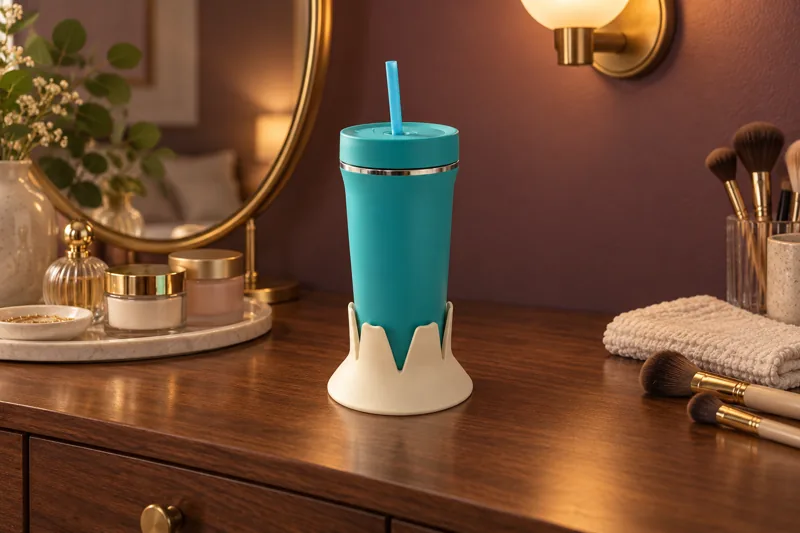
That's what Steadi is for. It's a single piece of Shore 85A TPU — never silicone — with a fixed 5.2-inch base that doesn't expand, contract or deform, standing 2.8 inches tall, and fins that flex to grip the bottom inch of whatever you set into it. The mechanism is simple geometry: the fixed base widens the base of support, so the container's centre of mass has to travel further horizontally before it passes outside that base, and tipping therefore takes a much larger tilt. The TPU's tack resists sliding on the exact surfaces this room has — laminate with powder on it, stone with condensation on it. It resists tipping and it holds steady. It's molded in Orange, California, patent pending, dishwasher safe, with 90 days from delivery to send it back, used and free.

The limits belong in the same breath, because this article is about a room with live power in it.

The twenty seconds after, if it happens anyway

Worth reading once now rather than working out in the moment.

If liquid reached anything live, kill the breaker before you touch anything — not the switch on the strip, the breaker. Then unplug at the wall, and only if the receptacle and the plug are dry.

Never run a wet tool to dry it out. Not the dryer, not the iron. That's the exact scenario the immersion protection exists for, and it's a one-time card.

A soaked dryer is replaced, not rescued. CPSC's own recall remedies tell consumers to cut the cord in half and photograph it — that's the standard of destruction the agency expects for a dryer that shouldn't be used (CPSC recall, Empower Brands/Remington).

While you're here: go look at your dryer's plug

This takes five seconds and it's the highest-value thing in this article.

Pick up your hair dryer and look at the plug. It should be a large block-shaped plug — that block is the characteristic CPSC calls readily observable, because it is what houses the circuit interrupter. It will usually, though not always, carry TEST and RESET buttons. If it's a thin ordinary two-prong plug with nothing on it, that dryer does not have immersion protection, and it's the exact defect CPSC has been recalling continuously — Empower Brands pulled about 56,300 Remington-branded dryers in August 2025 for lacking an immersion protection device; AliExpress ran three separate hair dryer recalls on a single day in April 2025 — a foldable travel model, a mini travel model and a full-size negative-ion dryer, about 160 units between them (the foldable travel one here); McLee Creations recalled its MyOnlyStyler root booster dryer in November 2025 (CPSC recall). Note the first one: 56,300 units of a brand you'd find at a drugstore. This is not only a mystery-marketplace problem.

If your plug has the buttons, press TEST with the dryer running. It should cut out. Press RESET and it comes back. If it has the buttons and won't do both, it's done.

The bridal-suite version

Everything above compresses badly in a hotel room, which is why wedding mornings go wrong. One dresser, six people, a steamer that is a live water appliance, garment bags moving through, a photographer walking backwards, and a dress that has exactly one chance.

Two decisions handle most of it.

Designate a drinks surface that is not the glam surface. The desk, the coffee table, the windowsill — anything that isn't the dresser everyone is working at. It has to be lower than the dress's hem line and out of the walking lane, and it needs to be announced out loud once, at the start, before anyone's had a mimosa. Nobody will follow a rule they weren't told.

Put the hot tools in the bathroom. Hotel bathrooms entered the NEC's GFCI list in 1984, so a hotel built or renovated since the local adoption of that edition should have a protected receptacle at the basin, the counter is hard and non-porous, and the basin is right there as the cheapest possible downhill. It's also a different room from the dress, which is the whole point.

The mimosa flutes are the genuinely hard case — small foot, high centre of gravity, and the worst possible contents to spill on silk. There's no clever answer to a stemmed glass on a crowded dresser except the boring one: don't put them there.


Nothing on this list costs money except the ten minutes it takes to walk your own routine once with your eyes on the desk instead of the mirror. Watch the cord's arc. Find which way water runs on your top. Give the iron a bay. Then, and only then, decide where the cup goes — and pick the corner where the worst-case outcome is a towel and a mild inconvenience.

Wondering about your specific cup? The fit database has sourced base measurements for 30+ containers — Stanley, Red Bull, Yeti, and the honest no's.

Sources

  1. Electronic Code of Federal Regulations, 16 CFR Part 1120 (CPSC) — 16 CFR 1120.3(a) deems a substantial product hazard any hand-supported hair dryer that does not provide integral immersion protection in compliance with section 5 of UL 859, OR section 6 of UL 1727 (t
  2. Federal Register, 76 FR 37635, CPSC final rule 'Substantial Product Hazard List: Hand-Supported Hair Dryers' (28 June 2011) — Immersion protection is a GFCI/ALCI/IDCI in a large block-shaped plug that cuts power 'in a fraction of a second'; the plug 'usually' also has Test and Reset buttons. UL first required protection with
  3. Wikipedia, 'Residual-current device' — NEC GFCI locations were added over time: bathrooms and outdoor areas 1975, garages 1978, hotel bathrooms 1984, kitchen counter sockets 1987, crawl spaces and unfinished basements 1990, kitchens genera
  4. Wikipedia, 'Hair dryer' — A modern hair dryer can use up to about 2,000 W.
  5. Journal of Burn Care & Research (2008), 'Burns in children caused by hair straighteners: epidemiology and investigation of heating/cooling curves' — Hair straighteners tested across four brands had a mean peak temperature of 169.5 C and remained above 80 C for between 6 and 8 minutes after switch-off; one third of burns in the series occurred whil
  6. Burns (2008), 'Electric hair straightener burns: an epidemiological and thermodynamic study' — Straighteners reached 145 C within two minutes of activation and took up to seven minutes to cool below a temperature that would burn adult skin on a one-second contact.
  7. Annals of Burns and Fire Disasters (2019), 'Beauty is pain: pediatric burns resulting from hair curling and flat irons' — Ceramic and metal straightening and curling irons reach up to 450 F in as little as five seconds; in a 59-case series, 61% of burns came from touching an iron within reach, 17% from one left on the gr
  8. U.S. Consumer Product Safety Commission recall (via CPSC SaferProducts recall API) — About 11,200 ANNQUAN power strips sold on Amazon were recalled in December 2025 because they do not contain supplementary overcurrent protection, creating a fire risk if overloaded.
  9. U.S. Consumer Product Safety Commission recall (via CPSC SaferProducts recall API) — About 5,543 CCCEI power strips were recalled in March 2026 for the same lack of supplementary overcurrent protection.
  10. U.S. Consumer Product Safety Commission recall (via CPSC SaferProducts recall API) — About 56,300 Remington-branded hair dryers were recalled in August 2025 for lacking an immersion protection device; the remedy instructs consumers to cut the cord in half and submit a photo.
  11. U.S. Consumer Product Safety Commission recall (via CPSC SaferProducts recall API) — AliExpress recalled foldable travel hair dryers (about 80 units) on 3 April 2025 for lacking an immersion protection device; two further AliExpress hair dryer recalls issued the same day cover mini tr
  12. U.S. Consumer Product Safety Commission recall (via CPSC SaferProducts recall API) — McLee Creations recalled about 740 MyOnlyStyler root booster hair dryers in November 2025 for lacking an immersion protection device.
Pick a pack — ships free

Purchases go through steadilabs.com — the maker, directly.